



Every September I have the same conversation with at least one brand. They call in the second week of the month, excited about the holidays, ready to go big on CTV — and then we walk backward from Black Friday together and watch their faces change.
Here’s the math. Black Friday is November 27 this year. Traffic on CTV starts climbing a good month before that, and shoppers start even earlier: roughly four in ten begin their holiday shopping before November even arrives,[1] and our friends at tvScientific found in their 2026 Holiday & Seasonal Shopping Report that Millennials, the generation with the most gift-buying to do, start purchasing in October.[2] As the report puts it, “by the time the biggest sale begins, the consumer decision is often already in motion.” If your commercial isn’t live by the last week of October, you’re not early. You’re on time at best, and every week after that you’re paying full holiday CPMs to reach people who have already made up their minds. And this year there’s an added squeeze: the midterms land on November 3, and political campaigns are projected to pour a record $2.5 billion into CTV, most of it in the weeks right before Election Day.[3] Holiday advertisers will be competing for October inventory with candidates who don’t care what a CPM costs.
So this month’s post is part strategy, part production checklist, and part nudge. The holidays are closer than your calendar says. Let’s talk about how to make the most of them.
Why the Holidays Are CTV’s Moment
Streaming hours rise about 20% in Q4 compared with the rest of the year, and holiday programming viewership spikes two to three times around Thanksgiving and Christmas.[4] People are home, they’re on the couch, and they’re watching together. Just as important, they’re in a buying mindset. In a recent LG Ad Solutions and The Trade Desk study, one in three viewers said CTV ads shaped their gift-giving plans.[5]
And they’re not just watching. tvScientific’s report found that 52% of viewers look up products they see on TV while they’re still watching, and 58% browse online shopping with the TV on.[6] On CTV, the couch is the storefront.
That’s the good news. The challenge is that everyone else knows this too. In tvScientific’s survey of marketers, 81% plan to run Performance TV during the holidays and 71% have increased their seasonal budgets, which is why rising media costs top the list of things keeping them up at night.[7] Inventory tightens, CPMs climb, and a viewer in December sees more commercials in a night than they do in a typical week in April. A spot that’s merely fine gets lost. The brands that win the season are the ones whose creative does more work per impression — the right offer, to the right audience, at the right moment, and refreshed before it goes stale. That is where Carpe Canum comes in.
Over the past three years we’ve stopped thinking of a holiday commercial as one thing you make, push live and hope for the best. It’s about flexible creative that can be modified quickly based on performance data. We’ve built a creative toolkit that lets an advertiser create versions of their commercial for specific audiences — whether that’s a change in messaging or a different product surfaced — and do it quickly and cost-effectively.
Start With the Right Foundation: Traditional Production Still Matters
Before we get to the newer tools, a word about the old ones. There is no substitute for a well-produced hero spot. Real product, real people, real light, a director who understands pacing and a producer who knows where the money should go. That foundation is what every version, variant and AI-assisted iteration is built on. If the hero is weak, no amount of personalization fixes it.
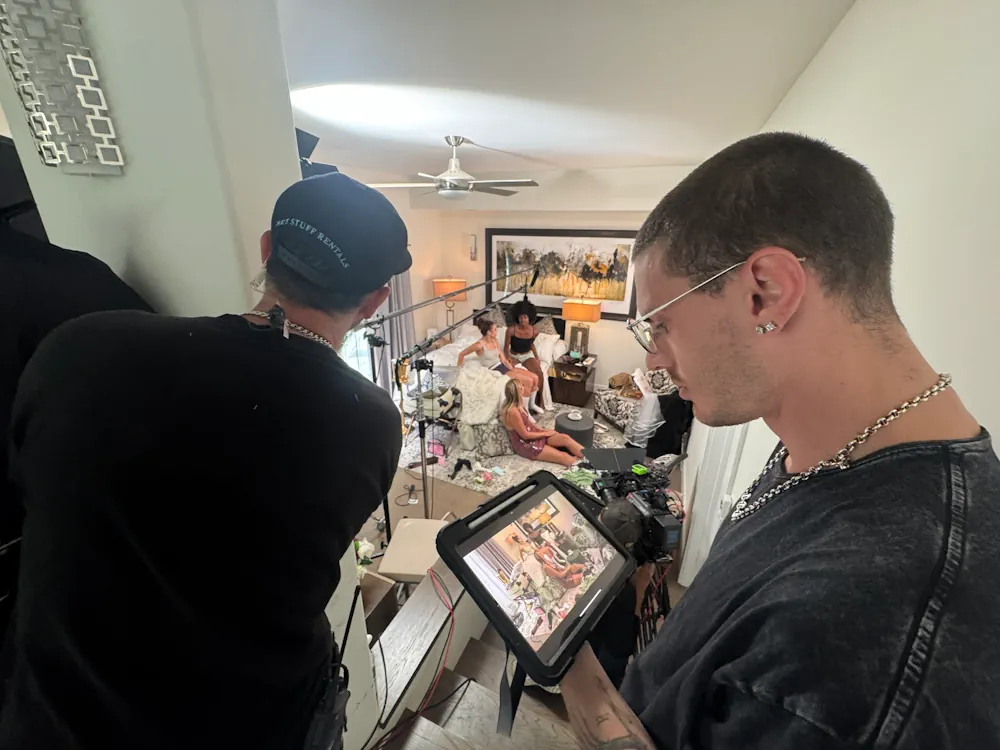
If you have the budget, that means shooting with the whole season in mind, not just the launch. We plan the shoot so the footage covers early gifting, Prime Day, Black Friday and Cyber Monday, the “ships by Christmas” crunch, and the post-Christmas window when 70% of shoppers are still spending.[8] Extra product angles, alternate line reads, a few seconds of clean background for title cards. It costs very little on the day and saves weeks later.
And if you don’t have the time or budget for a full shoot? We’ve built strong CTV spots from a brand’s existing library — social content, product photography, past campaign footage. Wildgrain came to us with a folder of vertical social clips and left with two product-focused spots that drove a 27% lift in conversion.[9] Holiday-ready creative doesn’t always start on a soundstage.
Modular Creative: Build Once, Run All Season
A modular spot is designed from the first conversation to be taken apart and put back together. The hero story stays constant; the offer card, the end card, the voiceover tag and often a mid-spot product beat are built as swappable modules.
Why this matters in Q4: your offer will change, maybe because of inventory, maybe because something takes off unexpectedly. It always does. The early-bird promotion becomes the Black Friday doorbuster, which becomes the Cyber Monday code, which becomes free expedited shipping, which becomes the gift card push on December 22. With a traditional spot, each of those is a new edit, a new approval cycle and a new week on the calendar. With a modular build, a new version is a matter of hours — we routinely turn iterations in 12 to 48 hours instead of weeks.
It also lets you show up for the moments before the big one. tvScientific’s own spend data shows October Prime Day running 250% above a normal day, higher than Black Friday or Cyber Monday, yet most brands don’t launch their holiday creative until November.[10] A modular build gives you a Prime Day version, an early-gifting version and a Black Friday version from a single production, so you’re in market when the research starts, not just when the sale does.
Modular Creative is also what makes real testing possible. Run two offers against each other the first week of November, read the results, and put the winner in heavy rotation before Thanksgiving. The old 1980s “doughnut” spot — a fixed open and close with a swappable middle — was the analog version of this idea. CTV just lets us do it at the speed the season actually moves.
High Volume Personalization: Relevance at Scale
Modular creative solves the “one spot, many offers” problem. High Volume Personalization (HVP) solves the “one spot, many audiences” problem.
HVP takes your data — geography, audience segment, product line, offer, retail partner, compliance requirement — and turns it into a version map, then produces every version in that map through an automated, QC’d pipeline. We’ve delivered 70 versions in 24 hours. For the holidays, that looks like:
- Regional versions that name the local store, the local weather, or the local shipping cutoff
- Audience versions that lead with the gift for him, for her, for the kids, for the person who has everything
- Retailer-specific versions for brands selling through multiple partners
- Offer-tier versions that match the promotion running in each market
- Dynamic end cards that update as deadlines approach — “order by December 19 for Christmas delivery”
The result is a campaign where a viewer in Minneapolis and a viewer in Miami both see something that feels made for them, and the media team can match creative to targeting instead of running one message against every segment and hoping it lands.
Generative AI: More Options, Faster — With a Producer at the Controls
Regular readers know where I stand on Gen AI: it’s a force multiplier for production expertise, not a replacement for it. For the holidays specifically, that multiplier is worth a lot, and marketers have noticed. In tvScientific’s report, the top reasons advertisers are using AI for seasonal campaigns are faster creative development (42%), faster campaign launch (39%) and more creative variations (36%).[11] That’s a pretty good description of what a holiday calendar demands.
Gen AI lets us explore looks in a day that used to take a week of pre-production. It gives brands who could never afford animation a path to a fully animated holiday spot, as we did this year for myFICO and UTG Reaves. It lets us generate seasonal set extensions, snow where there wasn’t snow, a wreath on a door that was shot in July. And in our AI focus group testing, it lets us pressure-test a script or an offer before we commit a shoot day to it.
What it doesn’t do is make the judgment calls. The last 25% — the pacing, the visual hierarchy, the hallucinated product detail that a viewer can’t name but absolutely feels — still comes from a producer who has done this for a living. Our process is human-led whichever tools we use, and that’s especially true when a brand’s biggest quarter is riding on the work.
The Calendar: Working Backward From Black Friday
Here’s the schedule we’re running with clients right now. Adjust for your own launch date, but not by much. And if you want a version in market for Prime Day in early October, move everything below up by two weeks — which means the time to call is this week.
Mid-September: Strategy and version map. Decide the hero concept, the offers you’ll cycle through, the audiences and regions you’ll personalize for, and which tools fit the job. This is the week to call us.
Late September to early October: Pre-production and the shoot, or asset gathering if we’re building from existing content. Gen AI look development runs in parallel.
Mid-October: Hero edit, approvals, and the modular build. Music, sound design, graphics templates locked.
Late October: HVP versions produced, QC’d and delivered to your media partner. First flights live to catch the 42% of shoppers who start before November.[12]
November through December: Swap offers, refresh end cards, test and optimize. Because the system was built for it, none of this requires going back to square one.
If that timeline looks tight, that’s the point. Traditional production alone needs six to eight weeks from kickoff to delivery. Our newer tools compress the back half of that dramatically, but they can’t invent the front half. The strategy, the shoot and the hero edit take the time they take. Start now and you have room to be thoughtful. Start in mid-October and you’re choosing between rushed and late.
Our Take
The best holiday CTV campaigns we’ve been part of weren’t the ones with the biggest budgets. They were the ones where the creative was built to keep working: a strong, well-produced hero at the center, modular pieces that let the offer evolve week to week, personalization that made a national buy feel local, and AI tools used with a steady hand to move faster without cutting corners. That combination is how an advertiser gets more out of every dollar of media — not by buying more impressions, but by making each one count.
Traditional Production, Modular Creative, High Volume Personalization, Generative AI. They’re not competing approaches. They’re one toolkit, and the brands that plan early get to use all of it.
The holidays are closer than your calendar says. If you want your commercial live before the season gets loud — and built to stay fresh until the last shipping cutoff — let’s talk: carpecanum.com/contact-us
[1] Paramount Advertising, “Holiday CTV Advertising 2026: Why It’s Time to Plan Now,” citing PwC Holiday Outlook 2025 and CIT Bank/Harris Poll.
https://adsmanager.paramount.com/insights/holiday-ctv-advertising-paramount-viewership
[2] tvScientific, 2026 Holiday & Seasonal Shopping Trends Report.
https://www.tvscientific.com/2026-holiday-seasonal-shopping-report
[3] AdImpact, 2025–2026 Political Projections Report, projecting $2.48 billion in CTV political ad spend for the 2026 cycle, up roughly 20% from 2024, as reported by The Current, September 15, 2025.
https://www.thecurrent.com/marketing/streaming-fuel-record-us-political-spending-2026-ctv
[4] Paramount Advertising, citing VIZIO viewership data and Nielsen, 2024.
[5] LG Ad Solutions and The Trade Desk Intelligence/Appinio, January 2026, as cited by Paramount Advertising.
[6] tvScientific, 2026 Holiday & Seasonal Shopping Trends Report, consumer survey on multi-screen behavior while watching TV.
[7] tvScientific, 2026 Holiday & Seasonal Shopping Trends Report, marketer survey. Rising media costs were the top concern at 38%.
[8] National Retail Federation and Adobe, 2025 holiday data, as cited by Paramount Advertising.
[9] Carpe Canum, “How Wildgrain Found the Right CTV Recipe.”
https://carpecanum.com/how-wildgrain-found-the-right-ctv-recipe-with-carpe-canum-in-the-kitchen/
[10] tvScientific internal spend data, 2025: October Prime Day 250% above daily average, Black Friday 87% above, Cyber Monday 88% above. 2026 Holiday & Seasonal Shopping Trends Report.
[11] tvScientific, 2026 Holiday & Seasonal Shopping Trends Report, marketer survey on AI usage for seasonal campaigns.
[12] Paramount Advertising, “Holiday CTV Advertising 2026: Why It’s Time to Plan Now,” citing PwC Holiday Outlook 2025 and CIT Bank/Harris Poll.
https://adsmanager.paramount.com/insights/holiday-ctv-advertising-paramount-viewership